

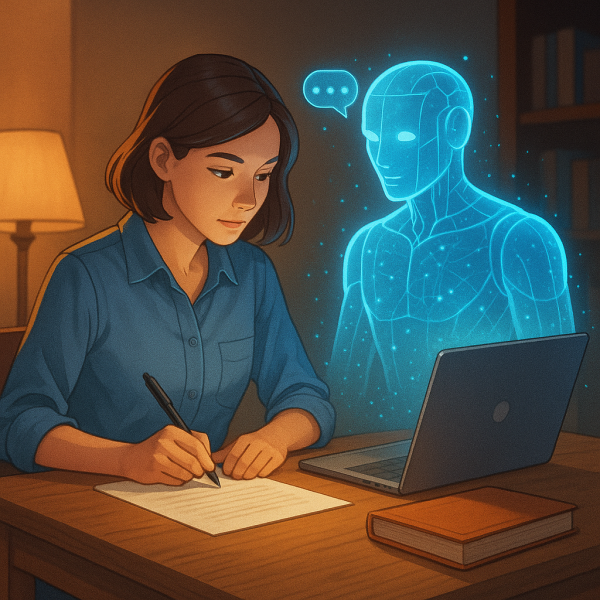
 I recently had the opportunity to attend the Write His Answer 2025 conference, where I led a few workshops and sat on a panel discussing the role of AI in writing. Naively, I assumed the other panelists would share my perspective on how AI should be used by writers. However, from the very first question, it became clear that our viewpoints diverged significantly. While the other panelists argued that AI is used to make the writing process faster and more efficient, I believe AI should be seen as a tool for improving the quality and depth of the final product. I don’t often write blog posts under my own name but I felt compelled to follow up. This post is my attempt to offer the research and reasoning behind my perspective, so that others can better understand why I hold the view I do. And perhaps, with time and thoughtful dialogue, more people will begin to see AI not as a shortcut to creation, but as a tool for supporting and enhancing the creative process itself.
Here are a few guidelines we share with our clients (and follow ourselves) when using AI to support, not replace your voice:
You don’t need expensive AI tools to get started, just a strong prompts and the free version of ChatGPT can begin enhancing your work right away. Download our free prompt and AI checklist, compatible with both the free and paid versions of ChatGPT.
In reflecting on the panel discussion, It was affirming to discover the study AI Writing Assistant: A Comprehensive Study by Boynagryan and Tshngryan (2024), which explores many of the same tensions. The authors found that AI writing tools clearly enhance efficiency—automating grammar corrections, providing rapid idea generation, and streamlining revisions to help writers move faster through early drafts. At the same time, their research also emphasized that this very efficiency frees writers to focus more of their mental energy on creativity and refinement. By offloading technical and repetitive tasks, AI enables writers to invest more deeply in shaping thoughtful, high-quality work. So while AI can certainly be used to make you faster, I still believe its greatest value lies in freeing up your mental resources to focus on crafting the best possible final product. At Celebration Web Design, we strive never to use AI as a shortcut, but rather as a tool that enhances, not replaces, the quality of what we create.
At first glance, AI tools like ChatGPT seem like a dream come true—especially for writers, marketers, and content creators. But as we discovered during our research and daily client work at Celebration Web Design, there’s more to the story. With a single prompt, you can brainstorm headlines, polish a draft, or churn out an entire blog post in minutes. At Celebration Web Design, we use these tools every day to streamline SEO writing, map out content, suggest titles, and provide fast editing help.
But there’s a deeper cost to consider and it’s not just about quality or originality. It’s about how your brain engages in the act of writing itself.
A 2025 study from the MIT Media Lab titled Your Brain on ChatGPT: Accumulation of Cognitive Debt when Using an AI Assistant for Essay Writing found that writers who relied on ChatGPT showed significantly reduced brain activity, particularly in areas tied to memory, language, and critical thinking. Even more striking: up to 83% of those who used AI couldn’t recall what they had written, compared to just 11% of those who wrote independently. In contrast, the “brain-only” writers scored higher in originality, clarity, and depth. Their work felt more personal, reflective, and grounded in real human insight (Kosmyna et al., 2025).
So while AI can certainly make the process faster, the study raises a compelling point: the more you offload to AI, the more you risk offloading your own thinking, memory, and creative voice. Interestingly, the participants who first wrote independently and then used AI in a second step for refinement maintained higher levels of creativity and originality, suggesting that when AI supports rather than replaces the writer’s process, the human touch remains intact.
Concerns about diminished originality and critical thinking are echoed in a 2024 study from King’s College London by Chahna Gonsalves, Generative AI’s Impact on Critical Thinking: Revisiting Bloom’s Taxonomy. Through a four-week observational study, Gonsalves found that students who leaned heavily on AI early in the writing process demonstrated reduced performance in higher-order thinking tasks—such as analysis, synthesis, and evaluation—compared to those who initially developed their own ideas before introducing AI assistance. The research highlighted that AI can be a powerful amplifier of structured thinking only when the foundation is laid by the human writer. The findings reinforce the notion that AI should be used not as a shortcut to ideation, but as a strategic companion for refining and strengthening ideas rooted in genuine human insight.
Not quite. AI doesn’t think—it predicts.
Think of it this way: AI is the most advanced auto-complete engine ever built. When you use Google, it gives you a list of existing results. Siri gives you a top-ranked answer. But AI tools like ChatGPT do something different: they use massive amounts of training data and advanced algorithms to predict the most likely next word or phrase based on your input, generating responses that feel intelligent, but aren’t grounded in true understanding.
Here’s what it can do:
But here’s what AI can’t do:
This distinction is more than philosophical, it’s fundamental. As Li et al. (2025) explain in The First Workshop on Large Foundation Models for Educational Assessment, large language models generate fluent responses based purely on statistical patterns. They lack any internal model of understanding, intention, or reasoning. What appears to be intelligence(thinking) is actually sophisticated pattern-matching, not real cognition.
So while AI may look like it’s thinking, it’s really just running an incredibly fast and complex prediction engine, echoing patterns from the past, not forming new meaning in the present. But beyond cognition, there’s another realm where AI’s limitations become clear: trust, authority, and how both readers and search engines evaluate your content.
As tempting as it may be to let AI handle your content strategy and creation, doing so risks more than creative flatness, it could seriously damage your visibility online. Google’s evolving search algorithms prioritize content that aligns with their E-E-A-T framework: Experience, Expertise, Authoritativeness, and Trustworthiness. That means your content isn’t just evaluated for how well-written or accurate it is, it’s ranked based on who wrote it, how qualified they are, and whether the information is backed by credible sources. These are, in many ways, the same criteria thoughtful human readers use when deciding whether to trust online content, prioritizing author identity, lived experience, and the credibility of cited sources (Jaleel et al., 2025).
In its official 2024 guidance, Google emphasized that content showing firsthand knowledge, original insight, and clear authorship credentials performs better in search results than generic or AI-generated text. This is especially true in areas where credibility matters, like health, finance, education, or faith.
AI can generate readable content, but it can’t reference personal experience or evaluate the credibility of sources the way a human can. While it’s true that AI can link back to trusted institutions and even cite sources, models don’t always distinguish between reliable and unreliable information with the nuance a person might. Worse, if an AI is trained on AI-generated text without safeguards, it risks amplifying prior inaccuracies. Drawing on the findings of Seitzhanov et al. (2025) and Wu et al. (2025), scholars agree that achieving reliable citation accuracy and source credibility in AI-generated content is still a major hurdle, especially in high-stakes arenas like academic synthesis and biomedical reviews.
That said, researchers are actively developing methods to improve how AI systems assess and weight the reliability of sources both before and after generating content. Simply relying on data from before the AI era isn’t enough; keeping models up-to-date with current, vetted information and teaching them to rank the quality of evidence will be key to their responsible use in writing, research, and education.
In short, AI can help shape your message, but if it’s doing all the talking your trustworthiness may take the hit.
In a world flooded with content, what sets you apart is you. The stories you’ve lived, the people you serve, the faith that inspires your work, these can’t be replicated by a machine. And when you partner with Celebration Web Design, we build tools that amplify your voice, not overwrite it.
AI is here to stay. So let’s use it wisely: not as a shortcut to skip the hard work of thinking and creating, but as a tool to enhance your unique perspective.
If you need help building a website or developing an SEO strategy, visit Contact Celebration Web Design to get started.
Disclaimer:
The views expressed in this article are my personal opinions, shaped by experience, research, and ongoing conversations in the writing and technology communities. Before using AI tools in your own work, be sure to consult applicable laws, copyright policies, and publishing guidelines, especially if you're submitting content professionally or commercially. What works well in one context may not be appropriate in another, and it’s important to use these tools responsibly and ethically.
Share This Blog:
250 Years Later: Can Your Website Help Build a More Perfect Union?
Jonathan Shank and the Celebration Web Design Staff
7/3/2026
What a Worn Coffee Table Taught Me About Spring Cleaning a Website
Jonathan Shank
6/9/2026
Why Building a Local Audience Creates Momentum for Your Website
Jonathan Shank
4/7/2026
How Author Websites Grow: Relationships First, Visibility Second
Joan
2/17/2026
What are 3 Blogging Strategies To Grow Your Base in 2026?
Jonathan Shank
1/5/2026
A Time for Reflection and Growth
Dr. Emily Shank
12/13/2025
Using AI Without Losing Your Voice
Jonathan Shank
8/4/2025
8 Fundamentals of SEO
Bruce and Jonathan
4/2/2024
What does Google want to see on your website?
Jonathan Shank
1/24/2024
What You Need To Know About SEO Terms & Featured Partner Marlene Bagnull
CWD Staff
7/25/2023
When Do I Need To Refresh My Website?
CWD Staff
3/22/2023
The Unchanging Word and The Changing Tools
Ed O'Leary
10/28/2022
EZ-CMS Version 4.0 Upgrade & Featured Client Leona Choy
Bruce Shank
1/16/2022
Email Apple Security Update
Jonathan Shank
9/9/2021
Food For Thought - Featured Partner - FarrHealthcare & Contact Form Update
CWD Staff
6/10/2021
Are Your Words Bearing Fruit?
Marlene Bagnull
3/23/2021
Our SEO Services in Celebration, Florida
Matt Beaulieu
1/13/2021
Video and Audio Page Updates
Jonathan
10/15/2020
Invoice Notice & Marketing Special
Celebration Web Design Staff
9/21/2020
The Anatomy of an Effective & Efficient Website
Bruce Shank
9/1/2020
Keeping Your Inbox Safe
Jonathan
7/10/2020
What kind of ROI are your investments getting?
Bruce Shank
7/8/2020
Invoice Update & Featured Partner Leona Choy
Bruce Shank
3/22/2020
Server Update & Featured Partner
CWD staff
6/10/2019
CWD Server Update
CWD Staff
4/24/2019
Featured Partner, Pastor Dan Allen
CWD Staff
4/22/2019
Featured Client Leona Choy
CWD Staff
7/16/2018
Privacy Policy Revision
CWD Staff
5/25/2018
EZ -CMS Blog Category Update
CWD Staff
6/19/2017
Celebration Web Design Launches New Website
Bruce Shank
5/25/2017
Proclaim17 NRB International Christian Media Convention and EZ-CMS updates
Bruce Shank
3/22/2017
Social Media Update
Bruce
9/1/2016
CWD Update
Bruce Shank
8/23/2016
Joan, Our Bookkeeper
Joan, Bookkeeper
5/25/2016
Blessings In Florida
CWD Staff
5/18/2016
EZ-CMS Additional Features
CWD Staff
11/10/2015
Trail Life USA
CWD Staff
11/6/2015
Lighthouse Baptist Church
CWD Staff
11/1/2015
We Are Blogging Now!
Jonathan,Vice President
10/20/2015